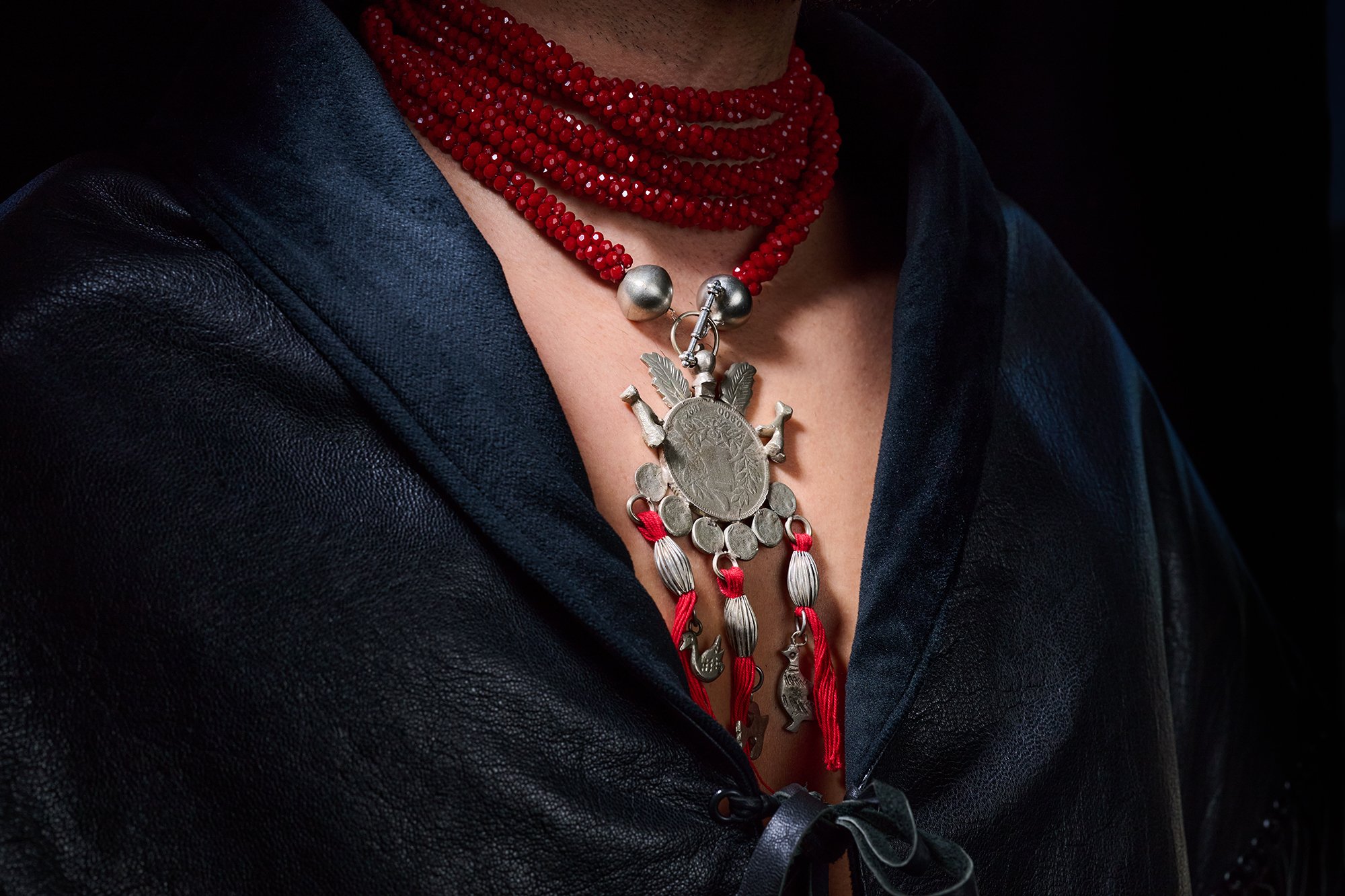
The chachal is a Guatemalan Maya necklace whose K’iche’ name echoes the sound it makes in motion. Composed of layered strands of beads, coral, silver, and coins, chachales carry social and ceremonial meaning, often passed down as inherited family wealth through mothers and grandmothers. This contemporary chachal with crocheted red Swarovski crystals is by K’iche’ Maya designer and artist José Luis Fernando Morales (Chichicastenango), who works in relationship with carvers, silversmiths, and elders across Guatemala to reimagine the form through intergenerational craft knowledge, including crochet techniques and new materials, affirming the chachal as a living technology of presence. Worn here with a black, reversible leather fringe poncho by Mexican brand Silo, a gender-free line of leatherwork made by Mexican artisans. Image Credit: Amber-Jayne Bain
In Conversation with Armando Perla: Market Knowledge, Circulation, and Indigenous Adornment
Venue: Te Papa Tongarewa, National Museum of New Zealand
Reading Room, Level 4
Date: Thursday 22 January
Time: 4:00–5:30 pm
Free event
Museum of New Zealand Te Papa Tongarewa, in collaboration with Te Whare Hēra, warmly invites you to a public conversation with curator and scholar Armando Perla, presented as part of their residency at Te Whare Hēra.
This talk brings together Perla’s long-term curatorial and research practice with a close examination of a living collection of Indigenous textiles, adornment, and sculptural works from Abya Yala (a Kuna term used by many Indigenous nations to refer to the Americas). Built over the past two decades through markets, powwows, studio visits, and sustained relationships across Canada, the United Sates, Mexico, Guatemala and El Salvador the collection foregrounds materials, techniques, and forms of knowledge that move across territories, waters, and generations.
Focusing on Cemanahuac (the Nahua word used to refer to Mesoamerica) in particular, Perla will reflect on works in their collection that engage weaving, carving, jade, ceramics, and bodily adornment, tracing resonances between Indigenous material practices in Abya Yala and those of Māori and Pacific artists encountered during the residency in Aotearoa. Rather than presenting the collection as a static archive, the conversation centers on the stories, relations, and responsibilities embedded in these works, and on collecting as a relational obligation, land-attuned practice shaped by movement, trade, and reciprocity.
Rather than culminating in a conventional exhibition format, this residency concludes with a provisional, market-informed curatorial gesture: a temporary presentation structured through Indigenous market women methodologies. Drawing on Perla’s own lineage of market women, this approach understands display as a form of circulation, encounter, and exchange, where knowledge is activated through proximity, movement, and storytelling rather than fixed institutional hierarchies.
The talk also marks a moment of convergence at the conclusion of Perla’s residency, bringing together their doctoral research, writing, studio visits, and curatorial dialogue. It offers insight into this market-based mode of presentation developed during the residency, while opening space for conversation between Indigenous artists and curators from across the Pacific, with attention to shared concerns around material knowledge, ecology, and Indigenous continuity.
The conversation will be moderated by Isaac Te Awa, Curator Mātauranga Māori at Museum of New Zealand Te Papa Tongarewa.
